

As renewable energy technology accelerates, the solar market is expanding at an impressive pace. Global Photovoltaic (PV) panel revenues, valued at $170.25 billion in 2023, are projected to reach $287.13 billion by 2030. In the U.S., momentum is even stronger: rising demand for clean electricity, falling panel prices, and federal incentives helped solar deliver 75% of all new gridconnected capacity in the first quarter of 2024. Solar PV Panels Market Size, Share & Trends Report, 2030
With solar infrastructure rapidly expanding, manufacturers and researchers must conduct comprehensive environmental testing to verify panel performance, assess material durability, and ensure every system meets strict industry and safety standards.
Climate testing of PV modules is an important aspect for manufacturers, research institutes and certifiers. The tests simulate rapid ageing of the modules by means of certain temperature changes and humidity levels and serve to determine the quality requirements of the PV modules.
Common Solar Panel Applications
Solar panels power everything from neighborhood homes to massive utilityscale farms to advanced aerospace systems—and in every setting, they face relentless environmental stress. Extreme temperatures, harsh weather, humidity swings, blowing sand, and saltmist corrosion all put longterm performance to the test. That’s why leading manufacturers rely on advanced solar panel test chambers to recreate these demanding conditions and prove their technology can stand up to realworld challenges.
This testing not only validates durability: it builds trust. Customers want assurance that their panels have been evaluated with the right equipment and the highest level of rigor. By adhering to internationally recognized standards from organizations like the International Electrotechnical Commission (IEC) and UL, manufacturers demonstrate a commitment to safety, reliability, and longterm performance. The result is powerful peace of mind. Buyers know their investment is backed by proven engineering, consistent energy production, and technology designed to deliver value for decades.
Two Types of Solar Panel Technology
There are the two primary types of solar panel technology: crystalline silicon and thin-film solar panels, each with distinct advantages and testing requirements.
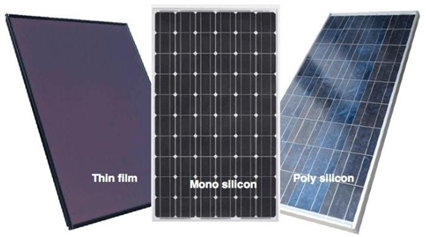
Crystalline silicon panels remain the industry standard and are available in two forms: monocrystalline and polycrystalline. Monocrystalline panels, crafted from a single silicon crystal, deliver the highest efficiencies, strong performance in high temperature environments, and exceptional longevity, often surpassing 30 years. Polycrystalline panels, made from multiple silicon crystals, provide a more cost effective option. While slightly less efficient in extreme heat, their affordability makes them a popular choice for largescale commercial and residential installations.
Thin film solar panels offer a different value proposition. Manufactured from materials such as cadmium telluride (CdTe), copper indium gallium selenide (CIGS), or amorphous silicon (aSi), these panels are lightweight, flexible, and ideal for applications where traditional modules are impractical. Although thin film technologies typically deliver lower efficiencies, their streamlined manufacturing process reduces cost, making them well-suited for utility scale deployments. They also excel in high temperature environments thanks to a lower temperature coefficient and can be installed on surfaces that cannot support heavier crystalline modules.
Standards for Safety and Design Qualification
Weiss Technik test chambers are engineered to meet common solar panel safety and design qualification standards including the following:
- UL 1703 – Safety standards for flat-plate PV modules
- IEC 61215 – Design qualification for crystalline silicon PV modules
- IEC 61646 – Design qualification for thin film PV modules
- ASTM E1171 – Test methods for photovoltaic modules
- IEC 61730 – Safety standard for photovoltaic Modules
- IEC 62108 Concentrator photovoltaic (CPV) modules and assemblies – Design qualification
Of these standards, UL 1703 is considered the most important for solar panel testing in the U.S., as cities and counties will only issue installation permits for solar panels with a UL 1703 certification. This protocol ensures that solar panels are safe and reliable under various environmental conditions. For more information on IEC, UL or ASTM standards or to purchase a copy of the full specification, visit the following web sites www.iec.ch, www.ul.com, or www.astm.com.
Key Considerations When Selecting a Testing Chamber
Choosing the right environmental chamber for solar panel testing requires a careful evaluation of several technical factors to ensure accurate, repeatable, and standard-compliant results. The first step is determining which industry standards the panels must meet, as these requirements dictate the specific test methods and environmental conditions the chamber must support.
Once the applicable standards are defined, attention shifts to how the panels will be tested. The chamber must deliver a precisely controlled environment capable of replicating a wide range of climatic conditions, especially temperature and humidity, which are critical for assessing real‑world performance and long‑term reliability. Noting that there may be a difference if the items tested are horizontally or vertically.
Chamber size is another key consideration. It must accommodate the maximum dimensions of the solar panels or modules under test, providing sufficient clearance to prevent airflow disruption or measurement interference. Equally important is the chamber’s ability to maintain stable, uniform conditions over extended durations, as long‑term cycling and degradation studies often require continuous operation. Size and location of the chamber is also important when thinking about the installation (height of ceiling, narrow doors, stairs) and the availability of cooling water.
Finally, the chamber should integrate sensors and a data acquisition system to capture performance metrics with precision throughout the test cycle. Accurate monitoring is essential for evaluating material behavior, identifying failure modes, and validating compliance with engineering and safety standards.
Temperature Cycling and Humidity Freeze Tests
Weiss Technik test chambers specifically designed for testing photovoltaic modules facilitate rigorous temperature cycling and humidity freeze tests. Temperature cycling tests evaluate the durability of solar panels by subjecting them to extreme temperature variations, cycling between -40°C to +85°C over 200 cycles. Each cycle lasts approximately 4.25 to 6 hours, resulting in a total test duration of 850 to 1,200 hours. This process simulates real-world thermal stress that solar panels may encounter.


Humidity freeze tests assess the ability of solar panels to withstand high humidity and freezing conditions. This test involves cycling the temperature from +85°C at 85% relative humidity to -40°C, with each of the 10 cycles taking about 22.3 to 24 hours, culminating in a total test duration of 223 to 240 hours.
Weiss Technik Options for Solar Panel Testing
Weiss Technik offers two main categories of test chambers for validating solar panel technology: reach-in or walk-in chambers. Models designed for testing full-size solar panels are best suited in the walk-in chambers, more specifically, the PV Series. Those suited for individual cells or small solar panels would fall into the reach-in category, more specifically the Endurance series.
The PV Series are specifically engineered for testing complete solar panels. These chambers can accommodate multiple panels simultaneously and are capable of performing temperature cycling, humidity freeze, and damp heat tests. To accommodate the larger dimensions and weight of full-size solar panels, the PV series feature spacious test space dimensions. The PV345 model has a workspace of 74″ x 96″ x 84″ (1880 x 2438 x 2134 mm) and can test 8 to 20 panels, assuming a weight of 55 lbs. (25 kg) per panel, spaced 4″ (102 mm) apart. And has the ability to reach a 95ºC @ 95%RH for shorter test times. Custom, larger workspaces are available for larger sized panels.
The Endurance series are designed for testing individual cells or small solar panels. These chambers are smaller in size compared to the PV series models, making them suitable for testing smaller samples. The ENDH-35 model, for instance, has a workspace of 43.3″ x 37.4″ x 37.4″ (1100 x 950 x 950mm) and can accommodate temperature ranges from -70°C to 180°C and humidity ranges from 10% to 98% RH.
The advanced design of Weiss Technik environmental test chambers, including unique airflow distribution and precise temperature control, ensures that solar panels are subjected to consistent and accurate testing conditions. Our LEEF™ (Leading Energy Efficiency Footprint) technology is a high-efficiency refrigeration system that provides unmatched performance; it features optimal temperature and humidity control accuracy for precise testing results, faster ramp rates, and up to 40% energy savings.
Acceleration of the environmental effects that these products will experience in nature is required. Reliability of the equipment to ensure the reproducibility of the test results is an absolute necessity. Weiss Technik provides the solution with testing chambers for solar panel technology. By understanding your needs, we deliver a solution that fits your facility and your business goals. For additional details visit weiss-na.com.